

“They wanted to perform, but they wanted to do it in a healthy way that they could sustain for decades.” Nick Petrie
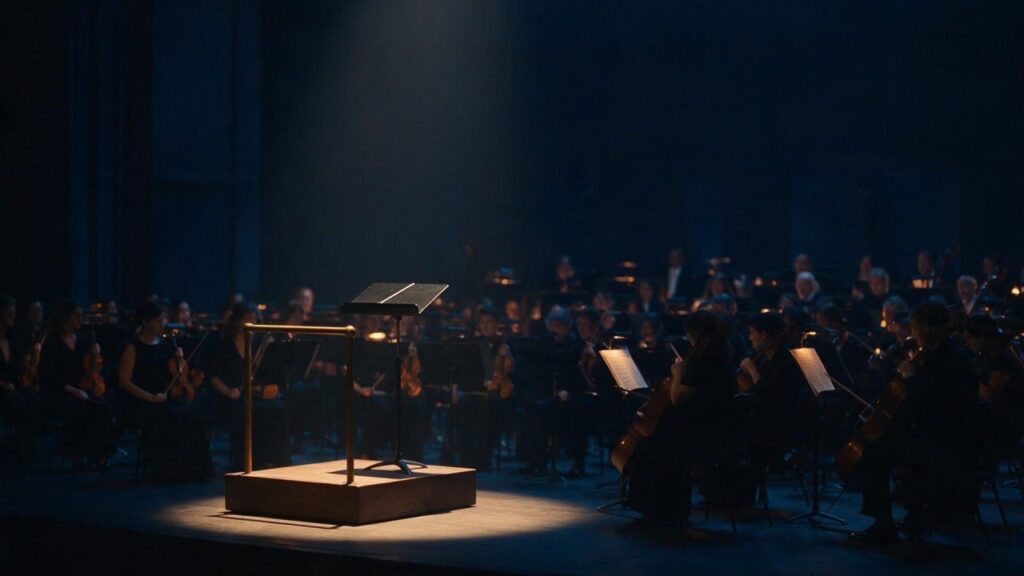
Our orchestra conductor once walked off stage in the middle of a concert for about ten minutes. We had no choice but to carry on. It was so draining, yet we all learned so much. He was always telling us to listen to each other and to focus, and in those ten minutes we found out why: the deep work of an orchestra is to really listen, not just to read music.
That story came back to me while I was talking to Nick Petrie this month, because so many of the teams I work with are playing without a conductor right now. Or with a conductor who is so busy playing every instrument that nobody is setting the rhythm. Teams are being reorganised and asked to adopt AI at the same time, often in the same quarter, sometimes in the same town hall meeting. More is coming into the system than the system was ever designed to process, and the people inside it can feel it long before any dashboard shows it.
Over the last four episodes of Let’s Talk Transformation I have spoken with Charlie Winton about building people infrastructure with AI (listen here), Dre Baldwin about operating systems for high performance (listen here), Denis O’Shea about scaling AI adoption safely and sustainably (listen here), and Nick Petrie about the achiever’s dilemma in the AI era (listen here). They are, respectively, a mental health tech founder, a former professional basketball player, a technology CEO who has watched three waves of adoption from the inside, and a sustainable leadership performance researcher. Every conversation ultimately arrived at the same place: looking at the system inside the leader, what happens when it is overloaded, and how that overload travels out into the team.
The system inside the system
We don’t talk enough about operating models, although they are what make the difference between sustainable systems and broken systems on steroids. The internal operating system of a leader takes in information, expectations, threats, noise and emotions; it processes them and produces decisions, behaviour, resilience and leadership presence. Put quite simply, the nervous system is the leadership operating system. And like any other system, it has a maximum capacity.
Donella Meadows gives us useful language for this. Stocks are what accumulate in systems: trust, tension, energy, stress, credibility, sleep. Flows are what fill or drain them. Overload is rarely one event – it is a stock that has been filling faster than it drains, for longer than we noticed, just like burnout rarely comes from just one thing. It turns up as a combination of a heavy workload, an internal voice saying I must deliver, I must push through, and a brain that never clocks off. In fact, if we haven’t dealt with these triggers, they will come with us from one system to the next. Our brain and body store experiences and muscle memory from all the systems we live and work in, and as we transition, if we do not intentionally ‘see’, it goes into the metaphorical backpack we carry – often making it heavier.
Last week, in the search for more clarity, my client and I mapped their system: decisions had moved fast, but authority hadn't moved at all. Everything still routed through her and her right-hand person. The feedback loops she was reinforcing (more dashboards, more check-ins) were the loops creating the overload. Finally, the leverage point wasn't a tool or an automation, but rather a shift in practices of who gets to decide and when. Donella Meadows tells us that the most profound leverage point in any system is the paradigm it arises from. In practice, that means the hardest work is on the leader’s own map — before anything else. Dre put it in even plainer terms. “Overwhelm is just a misalignment of priorities,” and then, “Any human will feel overwhelmed when you structure things in that way.” I love this because it takes overwhelm out of the realm of character and into the realm of design. His definition of confidence follows the same logic: competence minus interference. The competence is usually already there. The interference is what has flowed into the system uninvited: self-doubt, anxiety, noise, the stories I tell myself, or the next notification.
Simplicity is always the best leverage for understanding complex systems – in my Human Systems Practitioners programme we use simple language to describe the state of a system at any given moment: green, amber or red. Green is connected: able to hold tension and listen to understand. Amber is mobilised: speeding up, scanning for threat, centralising decisions, and either over-trusting AI or dismissing it. Red is shutdown: going through the motions. These are the (internal and external) states of the system, not types of people. Everyone visits all three, individually and collectively. The question is which one you lead from most, and what puts you there.
Regulating the intake
When we talk about regulation, we usually mean what we do once the pressure has arrived. Can we manage our emotional responses, balance our thoughts and step back into more deliberate thinking? This matters, of course, but often we need to look further upstream. Reorganisation, team dynamics and AI adoption are first and foremost an intake problem: what we allow into the system in the first place and how.
I have hope and a belief that AI can enable human connection and give people a little more space to think, breathe and recover. But this has not happened yet and people are falling victim to the opposite effect as productivity and busyness soar, as do the expectations of productivity – we are often acting on our old patterns but with new, more capable tools. If I blindly use AI and it can do everything 100 times faster, then I can do 100 times more. This is a recipe for burnout and disaster. Unless you intentionally protect your time and your brain, you fill your system constantly. You need gaps along the path to transition to allow for nervous system recovery and sense-making.
There is also the cognitive cost. We think we are multitasking, but we are actually task switching, and every time we switch, the brain has to reload, recalibrate and refocus. Now picture a team mid-reorganisation: new reporting lines, roles still being written, three AI pilots running, and the same delivery targets as before. That is not a team that lacks resilience or productivity, but a system whose intake has exceeded its capacity.
AI is accelerating our capacity to step into overwhelm. Nick Petrie’s ‘thrivers’ have a response to this: they build back in what he calls chosen constraints. They decide what they will and won’t let AI do, and when they will switch it off (listen here). Regulation, in other words, is not only about how we cope with what comes in, but also about the design of the upstream process and the gate.
From inner state to external triggers
Here is the part we tend to underestimate: my state does not stay inside me. If you are a facilitator, you know this more frequently than others – energy is contagious and cannot lie. We can read the emotional landscape and energy of a room before we say anything. This is important for us as facilitators, but also as leaders because our energy resonates through the entire team and it affects everybody, either positively or negatively. This really needs to be a consideration when preparing for communication, agendas and presence. If I walk into a reorganisation briefing in an amber state, the room catches the amber vibe before I have said a word.
Organisational life and AI adoption are full of external triggers: a new org chart with a box that doesn’t have your name in it (but nobody informed you); a job description that changes three times; a tool that can now do part of what you were hired to do; and an announcement with no detail and an implementation date to name but a few. Each of these things activates patterns that already exist in us, the very patterns we need to notice, step back from and intercept. When we don’t, the inner pattern becomes a team pattern, and then a system pattern.
Denis and I talked about what this looks like with AI. Faced with risk, a leader’s first reaction is often to control: lock down access, tighten policy training. Yet his research shows that the generation most likely to work around company systems when they hit friction is the youngest one in the workforce, and the way around is shadow AI (listen here). More control, more workarounds, more control: a threat response in one nervous system has become a reinforcing loop in the organisation. Leaders who can’t regulate recentralise under pressure, every time, and a reorganisation is exactly when authority needs to sit closer to the knowledge.
Teams send signals when their capacity is exceeded, and they are remarkably consistent.
- Cognitive narrowing: more rules, more processes, “just tell us what to do”.
- Relational withdrawal: people stop connecting, volunteering ideas and challenging; meetings become short and transactional.
- Performance volatility: a brilliant sprint followed by a collapse, with no recovery in between.
- Underlying fatigue: no one can maintain the energy required for delivery and space to breathe.
The trap is that these signals look like resistance, and resistance and dysregulation need opposite responses. Resistance is disagreement with the direction, purpose or method of the change, and it needs a conversation about purpose and better sense-making. Dysregulation is what happens when the pace or volume of change has exceeded the capacity of a person or a system to process it, and it needs different conditions: a slower pace, clearer boundaries and a safer space to speak. Almost all of us live and work in dysregulated systems – our own internally, and the external equivalents. If you treat dysregulation as resistance and push harder, the system shuts down even further.
What this means for leaders and teams in reorganisation and AI adoption
For leaders, the first implication is where we put our attention. As we know, and particularly today, there will always be a shiny new model that does amazing things. However, the leadership conversation needs to sit a level above the model and discuss the information architecture, the governance, and the human architecture. The technology arrives packaged and finished, and people arrive at their own pace with their own transition processes, and the distance between the two is where a transformation either succeeds or quietly doesn’t.
The second is about where we stand and what we see. The capacity to take a step back from the internal noise and get up on the balcony to look at the system in order to reflect, think and come back down onto the dance floor to engage is key to leading transformation. But, a lot of us get stuck on the dance floor, and stay there in either amber or red, trying harder to deliver. If I take the dance-floor view, AI is something to bolt on so we can go faster. From the balcony, though, the question becomes: should we even be doing this work, and should we redesign the process now that AI is available?
The third is about ownership. Who decides and when. This reminds me of a recent experience with a team where we were skirting round the issue of accountability for a failed project and nobody wanted to do a real retrospective, or take the lead for the next steps. Nobody wanted to say the words: this is the learning, I’m in charge, and this is what we’re doing. If you have ever lived through a reorganisation where nobody wants to own the decision or be clear about who does what, you already know how that feels in your body, and in your team. Every change programme I have worked on has this moment. It usually lands somewhere between month three and month four, when the launch energy has gone and the old ways of working creep back in along with the call of the comfortable and familiar status quo. This is not about more control, but about taking a step back and bringing clarity to the process and roles of the people involved.
Finally, it is about listening to voices. Charlie put the principle behind his platform simply: “if you give people a voice that they know that they’re protected with, they’re more likely to use that voice”. But an early warning system only works if somebody is prepared to see and answer the alarm. Otherwise we have built a sophisticated way of asking people how they feel and then ignoring the reply, which does more damage than not asking at all. This is about designing workplaces and tools intentionally to help people perform sustainably and to enable human flourishing – does it help me connect in a more human way, to have a better conversation? That design is a leadership job.
Five things to put in place
None of this needs a new framework bolted onto the old one. It needs a few deliberate structures, repeated until they become the way the team works.
A state check before every change conversation. For leaders. Before you announce a new structure, run a restructuring meeting or launch an AI tool, take two minutes and ask: am I in green, amber or red, and what will the room catch from me? If you are in amber, don’t make irreversible decisions in that state; move them, or test them with a peer first.
An intake gate for the team. For leaders and teams. List everything flowing into the team this quarter: reorganisation workstreams, pilots, tools, new reporting, standing meetings. Number the priorities one, two, three. For every new thing that comes in, agree what goes out or waits. Bring AI in through the same gate: use cases with priorities, then secure data, then training, then permissions for agents, then a way of measuring ROI. The newest model doesn’t get to jump the queue.
A changing / staying map. For teams in reorganisation. Uncertainty that nobody has mapped is an external trigger on repeat. For each team, write down what is changing, what is staying stable, and what is still undecided. Do the same for AI at role level: my role, AI’s role, and what we won’t hand over. Name who owns each decision. Create a one-pager that you can revisit monthly.
Read the signals before you respond. For leaders. When you see pushback, withdrawal or volatility, it isn’t necessarily resistance to change or disengagement. Run through one question before acting: is this an intelligent response to a flawed direction, or a biological response to system overwhelm? The first needs dialogue; the second needs different conditions. Give people a channel where they know they are protected, and tell them what changed because they spoke. In your one-to-ones, check what you are actually hearing on the four dimensions of the SHIFT Listening Index: factual clarity, emotional accuracy, strategic stakes and systemic framing (try here). What leaders fail to hear determines what organisations fail to see.
A team rhythm with a learning loop for the third day. For teams. Protect a recurring block of deep work time that no meeting is allowed into. Then put a thirty-minute review in the diary every two weeks: what is working with AI, what is drifting, and what will stop. Plan explicitly for month three and month four, before the launch energy goes. And do it together. Nick Petrie found that when individuals tried new habits together rather than on their own, it was easier, and it scaled to the team and then across teams.
Who sets the rhythm?
One of my favourite videos of orchestral impact is the one from Benjamin Zander who tells us that the conductor of an orchestra doesn’t make a sound, but depends on their ability to make other people powerful – to awaken possibility in other people. The conductor sets the structure, timing and rhythm, and keeps people on the aligned path. I think back to my own ten minutes as musicians without a conductor, and I think the lesson goes both ways. We carried on because we had learned to listen to each other. But it was draining because we were concentrating too intensely to listen, and nobody was holding the rhythm or orchestrating the whole. In a reorganisation, with AI arriving on top of everything else, the leader’s job is not to play every instrument faster. It is to regulate their own system enough to hear the orchestra, to decide what goes into the score, and to step up onto the balcony often enough to see whether the music sounds harmonious from up there.
So here is my question for you this week: what are you letting into your system, and what is it doing to the people around you?
Thank you for reading.
If this resonated, I go deeper every week on Thoughts on Human Systems, my Substack: essays, podcast conversations and practical tools for leaders redesigning how their organisations really work. Subscribe free here: https://thoughtsonhumansystems.substack.com/subscribe
You can also find more subjects like this in my podcast, Let’s Talk Transformation, available on Apple Podcast, Spotify and YouTube.
If you want to see where you and your team stand, take the 90-second readiness check for the Human Systems Practitioner programme. The next cohort starts on 5th January 2027: https://transformforvalue.com/human-systems-practitioner/#hsp-quiz
✍️ My writing now lives on Thoughts on Human Systems: essays and a community for leaders redesigning the human side of change. Subscribe free at thoughtsonhumansystems.substack.com