
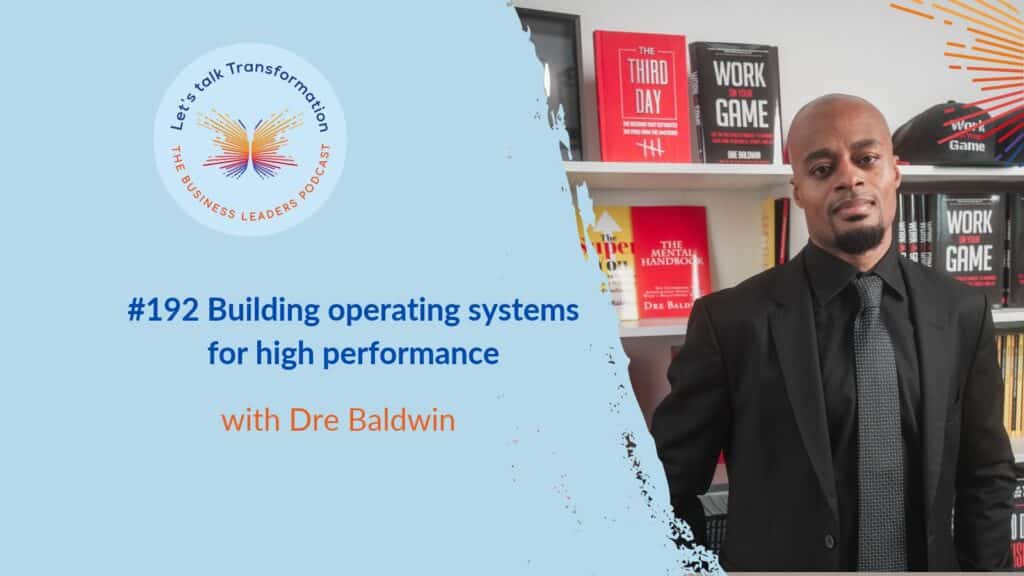
Dre and I discuss how turning potential into measurable results begins by defining the final objective and working backward. We explore how strategy must be deconstructed from the desired outcome to build reliable roadmaps and operational systems. Leaders must establish clear standards of execution and ensure that any deviations are identified and corrected promptly to maintain accountability.
Courage, Confidence, and Interference
Dre distinguishes between confidence, which feels positive, and courage, which requires stepping forward despite discomfort. To overcome pre-performance anxiety, we highlight the concept of “borrowed confidence”, allowing individuals to adopt the posture and energy of role models. Confidence si not an addition of traits, but more about the removal of mental interference such as self-doubt and overthinking. This reduction of internal noise allows natural competence to emerge during critical moments in sports, business, and leadership.
Presence and Nervous System ‘training’
Presence is not merely performed; it is trained directly into the human nervous system. Nonverbal communication accounts for the vast majority of human interaction. Tone, body language, and underlying energy convey more than spoken words ever could. It must be actively trained into the nervous system through intentional daily habits and posture adjustments. This physical and mental preparation lowers the barrier for courage and projects a signal of confidence that inspires trust and followership among teams.
Discipline and Managing Execution Drift
Many people struggle with consistency, wrongly believing that discipline is an innate personality trait. Discipline is simply a structural signal minus interference for Dre. When an individual implements a solid structure and removes distractions, disciplined behavior naturally follows. Every transformation program and personal journey eventually hits ‘the third day’. – when the initial excitement fades, nobody is watching closely, and the work simply needs to get done . When systems lack discipline, leaders must enforce standards to prevent execution drift caused by human entropy. High performers in chaotic environments often create tension if organisational standards do not match their level of execution. Maintaining motivation requires aligning priorities and establishing feedback loops that catch operational drag before it impacts bottom-line results.
Rest, Overwhelm, and Sustainable Success
We address the critical role of restorative rest in high performance, pushing back against today’s hustle culture and the myth of strong leaders can do it all. Dre shares athletic insights regarding physical recovery, noting that the human body requires rest to sustain output over time. Overwhelm is for Dre, a misalignment of priorities and advises focusing on single tasks sequentially rather than multitasking. Ultimately, sustainable success comes from refining execution and focusing energy on high-value results rather than simply increasing working hours.
Achieving excellence requires more than raw talent. It demands intentional structure, rigorous execution, confidence, and the courage to hold oneself and others accountable.
The main insights you’ll get from this episode are :
- Turning top performance into measurable results starts with the result then working backwards to achieve it.
- Business is a long game – a leader’s role is to establish execution and performance standards, enforce them, and rectify deviations.
- Courage before confidence: confidence feels good, courage often does not (a willingness to try despite an uncertain outcome).
- Confidence = competence minus interference (of self-doubt, anxiety, etc.) and gives off positive energy.
- Borrowed confidence is ‘borrowing’ energy from someone else: confidence is generally seen as an add-on, but it is a matter of eliminating interference.
- Hallmark of a professional is prior preparation – ask the right questions, prepare for what is going to come, fail initially but ready next time (battle testing).
- Training ‘power presence’ into the nervous system for higher performance – known as ‘command presence’ in military terms.
- Most communication is non-verbal; training involves body language, eye contact, etc. to give more presence, more confidence, and more courage.
- Energy is contagious and does not lie; energy management is about discipline and motivation.
- Signal for discipline is structure (then execution): in an undisciplined system, the stronger energy (e.g. of a disciplined person) prevails, or vice versa.
- Execution drift is a natural occurrence with humans (entropy) but is preventable by monitoring the execution of critical points in a process.
- Restorative rest in the business world is diametrically opposed to hustle culture, but humans biologically require rest (physical and mental).
- AI on top of hustle culture = overwhelm = misalignment of priorities; multitasking is actually task switching, which is inefficient use of the brain.
- Performance is designed to produce results, which are rewarded – leaders must define what success means to guide high performers.
- Execution is the bridge that turns potential/ideas into results.
Find out more aout Dre and his work here:
https://workonmygame.com/workonmygame-com-home
https://www.instagram.com/drebaldwin
https://www.tiktok.com/@workonyourgame
https://www.linkedin.com/in/dreallday/?isSelfProfile=false
https://www.drebaldwin.com/dre-baldwin-keynote-speaker–26974