
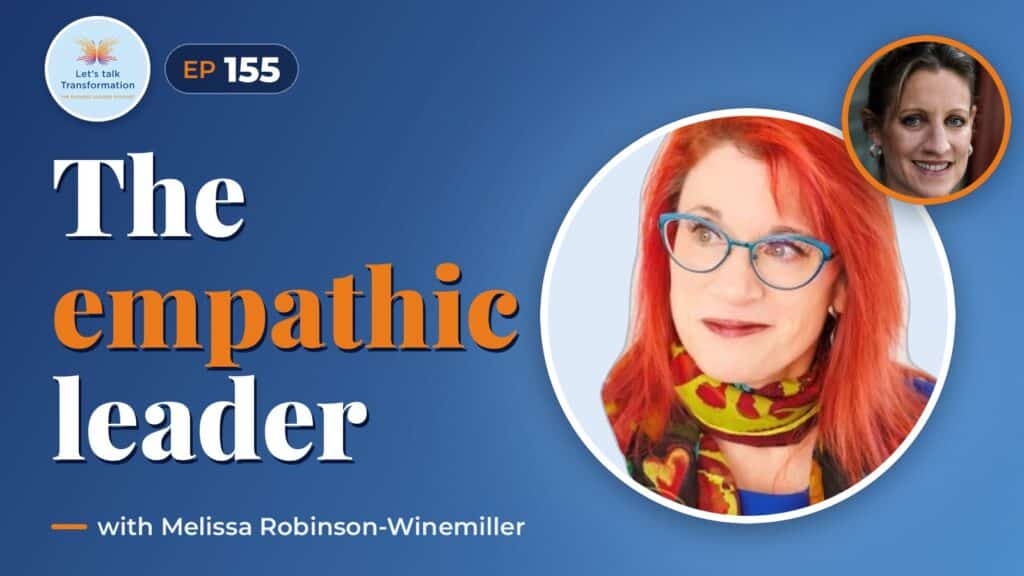
Empathy is no longer a “soft skill”; it is a hard skill, a disciplined practice, and a foundational architecture for organizational success
Research shows that leaders effectively employing empathy boosted productivity by 87%, innovation by 86%, and profit by 84%. These aren’t just “soft skills”; they’re hard metrics that directly impact your bottom line.
Melissa and I talk about why leaders often underestimate empathy and how to move past that. If you’ve ever felt like you’re hitting a wall in your leadership, or that your team isn’t as connected as they could be, this may be part of the answer. This is a common leadership pitfall: expecting people to adapt without understanding their perspective.
Leaders who lack self-empathy often create roadblocks, forcing their teams to “go around” them to get work done. This isn’t just inefficient; it erodes trust and hinders progress.
I particularly loved Melissa’s analogy of Stradivarius violins. They are beautiful instruments, but you only get their true value if you know how to play them. Without that skill, its potential remains untapped.Empathy is similar – it’s a powerful tool, but you need to know how to “make the strings sing” in your leadership. Our conversation made me reflect on how many leaders might intellectually understand empathy but struggle to connect and operationalize it daily.
We discuss how actionable empathy drives innovation, scales across teams, and why top organizations are placing it at their core. We explore the critical difference between empathy and self-empathy, and how a lack of self-awareness can derail even the best intentions.
How do you actively cultivate empathy & perspective-taking in your leadership approach?
Melissa shares her experiences, research and insights from working with leadesr and teams all over the globe.
The main insights you’ll get from this episode are :
- Making empathy actionable to help leaders operationalise empathy for themselves and their teams, using it to drive innovation and understand connection through perspective-taking.
- Leaders don’t view empathy as a skill and are often not connected to their people, representing an immovable object that people have to circumnavigate; without actionable empathy for themselves, they cannot apply it to lead others.
- Helpful to reframe empathy as strategic awareness rather than weakness – it takes courage to practice empathy whilst making difficult decisions; leading well requires the correct perspective.
- Four steps to self-empathy: self-observation, which leads to self-reflection, which leads to self-awareness, which leads to self-compassion.
- Judgement and empathy cannot exist in the same place: empathy in action is compassion, and a low-empathy culture ultimately produces weak leadership.
- An empathic culture has a leader in touch with what’s going on, making everything more efficient – empathy is important for middle management because they lead both up and down, and touch the most people.
- Practicing empathy takes discipline and energy and empathy fatigue can set in, especially with emotional empathy, which drains neurological reserves.
- Scaling empathy within leadership is about building a culture, living the asserted values – leaders are often unaware how their actions affect their people, which is the very opposite of inspiration.
- Operationalising empathy on a sustainable basis must be discussed in teams and integrated; it runs alongside change management and can survive hypergrowth if it is part of the culture and comes from the top.
- Leadership is an organism, whereas management is a machine – the former grows and requires nurturing; similarly, empathy in an organisation hugely improves productivity, innovation and profit.
- As a machine, AI has no empathy or perspective, so doubling down on the human connection enables better navigation of AI/tech; training people in empathy will hopefully make compassion the norm.
- AI can take over menial tasks, leaving people to shape the global perspective, social responsibility, etc.; empathy allows us to tap into human potential, scaling humanity as opposed to tech.
Find out more about Melissa and her work here :
https://www.amazon.co.uk/Empathic-Leader-Transforms-Leadership-Productivity/dp/1964014581