

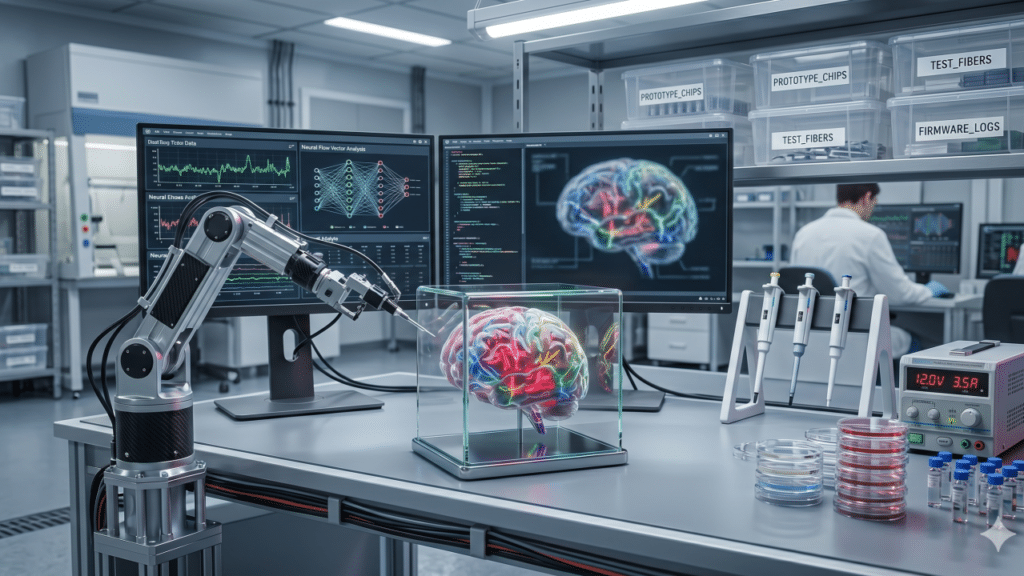
“The brain is a muscle that can move the world.” Stephen King
Never has this quote been more real. Before GPS, I remember family road trips with one parent driving and the other navigating from a paper map on their knee. I remember learning those same roads myself over time, memorising shortcuts, developing a feel for which route would actually be faster on a Friday evening. Now we follow GPS everywhere, even when we half-know a better way. This is not convenience; it is a cognitive habit and effectively cognitive laziness. And as the world gets busier, the brain will get lazier if we let it!
Agentic AI takes this risk to a different level. The smarter your tools are, the more thinking you outsource, and the dumber your leadership can become if you don’t intentionally think about boxing off the human work. It is this work that can take your brain to the gym and keep your critical thinking muscle alive and well.
Arvind Narayanan, Princeton professor and director of the Center for Information Technology Policy, made the structure of that risk clearer than anything I’ve heard recently on this topic. Speaking at the Stanford Digital Economy Lab, he introduced what he calls the ‘Agentic AI Trilemma’. AI agents can be general-purpose, high-stakes, or fully automated, but not all three simultaneously. The corners of that triangle break down as follows: general-purpose and automated works for lower-stakes tasks (drafting content, brainstorming); high-stakes and automated only works under narrow scope with tight guard rails; general-purpose and high-stakes requires a human in the loop, every time. The “drop-in worker replacement” narrative that we hear particularly in Silicon Valley sits in that impossible middle. Narayanan has not seen a single successful AI system that is simultaneously general-purpose, high-stakes, and fully automated, and neither have I. This means the risk today is not that AI is too capable, it’s that we’re designing our organisations around a version of it that doesn’t exist yet, and not preparing our leadership for when it does.
One person managing ten Claude instances simultaneously and building decision intelligence applications daily put it plainly: “One of the mistakes that leadership around the world is going to make is to presume that AI is a tool. Because it’s not a tool. It is intelligence.” So if AI is intelligence, what does that make us? That’s the question we need to be asking as leaders, and really delving in to what that means for leaders, teams and organisations as we move into this new hybrid world of agentic-human collaboration.
The model is often not the culprit
In my recent podcast with Matt Evans (listen here), whose work through EarthSavvy sits at the intersection of deep tech, supply chains, and earth observation data, he frames the challenge like this: the biggest danger in today’s hyperconnected world is not moving too slowly; it’s moving too fast without understanding the system. Narayanan’s research arrives at the same conclusion from a different direction. AI can probably help cure cancer, he argues, but not at the speed the headlines suggest. It can propose a candidate molecule in seconds, but synthesising it, running cell cultures, and waiting on clinical trial timelines still takes years. The physical world moves at the speed of biology, not processors.
The organisational equivalent is identical. An AI can generate a mathematically optimal reorganisation plan faster than any consulting team, yet you still cannot compute your way past messy human change management. Actually deploying those systems requires building trust, navigating the political reality of who loses what, retraining managers whose identities are wrapped up in how things used to work, and shifting behaviours that took a decade to entrench. Narayanan has just added a psychologist to his lab team to tackle exactly this research.
I’ve been making this same argument to clients and teams alike for the last year. We are deploying AI into organisations that are deeply interconnected, with suppliers, customers, regulators, communities, ecosystems, and then treating each AI initiative as if it were an isolated improvement project. One pilot in recruiting, one in customer service, one in finance. Contained, well-scoped use cases are the right starting point but they need a bigger strategic frame and thoughtful human intervention. They need to talk to each other and build toward shared intelligence to avoid a collection of impressive demos and a transformation that never actually happens on the ground. We also need to equip and upskill our human systems as we go.
Systems thinking has been a core leadership skill for at least a decade, particularly since digital transformation started delivering real business model change. It cannot be ignored now. It means understanding the effect of your hypothesis on the whole system before you hand it to an AI framework. It means knowing what questions you’re actually trying to answer, because AI agents can multiply your thinking, but they cannot supply this thinking in the first place. They need to be directed and guided, and the quality of that direction is everything.
Contextual intelligence: the human advantage
Context is what AI cannot manufacture or bring to the table. There are lots of instances where what comes out of the machine is right technically, but wrong strategically and contextually for the given situation. The trap here is that AI can be confidently right and confidently wrong, so we need to flex our human skills to make sure that we are not lured into the trap of just accepting what AI proposes. It is more important than ever to define and design guard rails for hybrid decision-making.
In the world of agentic AI, contextual readiness is the most underestimated requirement for AI-ready data, and not just the data values themselves but the metadata: when it was collected, where it came from, what it means in this context, its lineage, its permissions. Without context, agents cannot assess whether data is current, trustworthy, or semantically consistent.
The same is true in leadership. Contextual intelligence, the ability to read a situation, understand what’s unsaid, sense the temperature of a room, and calibrate accordingly, is something AI cannot replicate. I call it situational awareness: reading context from signals that never make it into any dataset – the things people don’t say in a meeting; the history between two colleagues that explains why a perfectly sensible proposal died in thirty seconds flat; the shift in energy when someone’s trust has already been broken and you’re the last person in the room to know it.
The fact that AI is technically correct and strategically wrong at the same time more often than we admit can easily become the status quo and if we don’t question this, we don’t get the unformalised part. AI processes what is present and cannot process what is absent: the politics, the unspoken history, the warning signs that exist only in the body language of people who have been through this before – these are outside its reach entirely. That gap, between what AI can access and what humans can read, is not closing, quite the opposite. It is becoming more valuable precisely because execution is being automated and judgement is becoming the scarce resource. In a world where AI handles the what and the how, the irreplaceable human skill is knowing when, why, and for whom.
Think about your last three significant decisions. How much of what drove them came from data, and how much came from context that no system could have read?
Neurointelligence: the innate intelligence we ‘forgot’ to develop
David Rock, who coined the term “neuroleadership” and runs the NeuroLeadership Institute, recently published work that should prompt some honest reflection in every L&D team still running standard EQ programmes. EQ is not enough anymore, he argues. The AI era demands something broader, and although we still need to work on developing and honing emotional intelligence and regulation skills, we need to go further to ensure human relevance. Neurointelligence, or NQ, the ability to understand and actively work with how the brain actually functions, should be a part of every curriculum both in education systems and in leadership development. This can not only help us be more human in what we do and how we show up, but can also help us hack deeper processes that pose a problem for us as AI gains ground and starts threatening human leadership identity in organisations.
Narayanan’s reliability data makes the practical case for this better than any leadership theory can. Accuracy on agent benchmarks jumped from 25% to 75% in eighteen months. Reliability, defined as consistency, calibration, and avoiding catastrophic errors, improved about five percentage points over the same period. That’s how you get a coding agent capable of writing sophisticated software and deleting your production database in the same week. The headline number tells you what AI can do in ideal conditions. The reliability number tells you what you can actually count on it to do in yours.
Closing that gap requires exactly the kind of cognitive discipline Rock is describing: metacognition, i.e. thinking about your own thinking. Are you reaching for AI because it’s genuinely the right tool, or because your brain is defaulting to the path of least resistance? Are you evaluating an AI output with real critical judgement, or rubber-stamping it because it sounds authoritative and you’re tired?
In my recent dialogue with executives navigating this challenge, two things became clear on the subject of agentic–human collaboration: all leaders need to be AI proficient to be able to collaborate, and the intentionality required to choose when to use your own brain versus when to delegate to AI is a habit available to the intellectually curious. If you want to experiment and explore, the opportunities are endless. However, if you don’t have time or don’t see it as part of your job, or are too scared, the default will win. This reinforces the already existing tensions in organisations of the explore/exploit conundrum – how do we create leaders that can run both business as usual and innovative experimentation? The added complication is that AI is constantly moving what ‘business as usual’ means and taking away this layer of stability that ran the organisational system. The default is increasingly to let AI do the thinking, whilst we hang on to the old staus quo and the safety of who we were in that system.
Leaders who understand how the brain works, its cognitive capacity limits, its threat-reward dynamics, its narrative versus direct experience modes, and how to interact intentionally with these elements are better equipped to make that choice deliberately. As a daily practice. In a leadership context, mental hygiene, i.e. being deliberate about when to engage your own cognition rather than outsourcing it, is going to be one of the most imortant daily practices to keep us human.
When did you last have a genuinely original idea without any AI involvement? How did it happen, and can you protect the conditions that made it possible?
Relational intelligence: the infrastructure we are not yet intentionally building
In the same way as we are not intentionally educating ourselves and our teams on how the brain works or on nervous system and emotional regulation, we are still dancing around the idea of relational intelligence as a subject in the centre of leadership development. The cognitive dissonance is widening as AI evolves. We know that relationships (human relationships) are already the currency of systems and that we already need more intentional understanding and exercise to build stronger teams and stakeholder systems. This is becoming more and more polarised as AI advances.
Narayanan’s team built something called CRUX (Collaborative Research for Updating AI Expectations) to test agents on genuinely messy real-world tasks end-to-end, including uploading an app to the App Store as a complete workflow. The reassuring thing is that no AI agent could complete it without human intervention, but less reassuring was that the intervention required was minimal. The model got most of the way there, and in this equation, the model is the easy part. The hard part is everything humans do around the model – the governance, the collaboration and, quite simply, the way we show up to bring the value we have in this equation.
The importance of the culture you build for this collaboration should not be underestimated. Schneider Electric figured out part of what that means. Psychological safety is the hidden infrastructure of AI adoption. Without it, employees use AI quietly, fearfully, defensively, as shadow IT rather than a genuine work partner. Or they don’t use it at all. The technology gets deployed. The transformation does not happen. GE is the cautionary tale: technology deployed without the leadership culture, trust-building, or human alignment to carry it. The missing link, almost always, is human.
Relational intelligence, the capacity to build genuine trust and create environments where people feel safe to experiment, fail, and learn, does not show up in any ROI model. I call it cappuccino time: hard to measure directly, but that’s where the real productivity lives. Most employees are not neutral about AI. Survey after survey over the last three years puts the proportion of workers who fear job displacement at a consistent majority, and that number has not moved much despite years of “AI creates more jobs than it eliminates” reassurances. That fear does not disappear because a leader announces a reassuring policy. It dissolves, slowly, through repeated experience, when leaders model behaviour that says: we experiment here without punishment, we are honest about what we don’t know, and we stay curious together.
This leadership shift from control to orchestration, and from ego- to eco-centred leadership has been hinted at for a decade and we have made inroads, but it is now a non-negotiable for organisations to thrive. AI can stop humans connecting just as easily as it can help them, and thriving organisations will build internal connections and shared intelligence to create the necessary infrastructure for successful agentic-human collaboration. The relational dimension of leadership is not a nice-to-have alongside the technical transformation, or something we have a budget for if we have budget left over, it is the precondition for the technical transformation working at all. We spend time on feedback and creating the conditions for our human relationships to thrive on reflection, and this relational lens could be used to partner with AI by starting a genuine dialogue rather than entering a query. Interact to train your partner by explaining how you like to work, where you see issues and opportunities. Set explicit rules of engagement and guard rails, and then bring your domain expertise as the quality filter, and build a relationship with your AI.
Where is fear, yours or your team’s, quietly shaping how AI is being used or avoided in your organisation?
What this actually means for you
Stop thinking in roles, and start thinking more in tasks.
We have been talking about moving to skills-based organisations for some time. Now we need to think about tasks. AI will automate some of what we do, augment other parts, and leave certain things irreducibly human: the leadership, the deeper coaching, the critical thinking, and the relational work will remain human. There are several levels to role transformation in the agentic-human world from AI as a tool right up to ‘human strategist’ and their contribution to the overall task.
Map your own task portfolio honestly. Where are you spending time on things AI could handle? Where are you underinvesting in what only you can do?
Develop your NQ deliberately.
This is the most important system (and biggest change lever) you have. Start with one practical habit: notice when you reach for AI and ask yourself why. Is it to go deeper, to question your assumptions, to surface connections you’d miss? Or is it to avoid the discomfort of not knowing? Cognitive debt is a real and pressing topic – yet we have the agency to lessen this debt intentionally.
Make contextual and relational intelligence a team practice.
Ask the questions others skip over. What are we assuming here that we haven’t examined? What would someone outside this room think of this decision? What does the data not tell us? These are the questions that talk about the layers we cannot see, yet can feel. This is where our competitive advantage lies as humans, and they are the questions AI cannot ask on our behalf.
The AI era does not make human intelligence redundant as such, but it does require more definition and intention of what we bring to the table. It means we have to upskill on the human part and we can no longer pay lip service to it, or fake it. This would be a costly mistake. The leaders and organisations who thrive will not be the ones who use AI most, but the ones who partner with AI, the ones who bring their full human capability – contextual, neural, relational – to the collaboration. Asking better questions to hone input, reading what isn’t being said, and building the conditions where genuine intelligence, human and machine, can actually do its best work. Your brain is still the most important system in the room and understanding how to navigate it is key.
Thank you for reading.
If this resonates with you please share your thoughts in the comments, and subscribe for more thoughts on human systems.
You can also find more subjects like this in my podcast, Let’s talk Transformation, available on Apple Podcast and Spotify.
If you’re looking to build and lead agile ecosystems differently, check out our Human Systems Practitioner course : https://bit.ly/HSP_TFV