

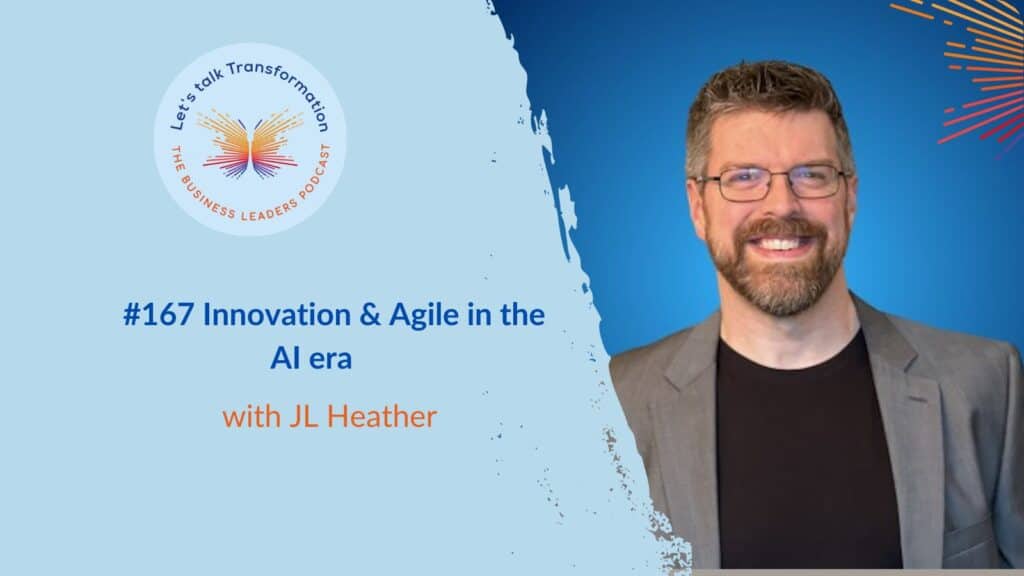
“If you truly want a competitive advantage, you have to start looking at the human systems involved, and make sure you understand your customer”
Remember when agile and lean felt like the magic bullet for every organizational issue? We embraced them, hoping to cut waste and move faster. For a while, they really did change things, but the frameworks became the main point, and many companies ended up with sticky notes and stand-ups that went nowhere. It’s a story I’ve seen play out too many times.What happens when the tools designed for change become barriers themselves?
This question becomes even more pressing with the rise of generative AI. Is this the long-awaited solution that will truly change everything? Is it the “magic wand” for better work? We discuss the reframe of agile and lean in an AI-driven world, where AI can generate, decide, and act. We also discussed what this means for humans who still need to connect, lead, and make sense of it all.
The reluctance to change often stems from what JL calls a “can’t culture.” This culture takes various forms :
- Political “can’t”: Resistance due to perceived loss of power or control.
- Financial “can’t”: Claims of insufficient funds, though some of these are not genuine constraints.
- Strategic and capability “can’t”: Limitations in strategy or skill sets.
- Structural “can’t”: Incentive structures that conflict with agile organizational goals.
When these factors converge, the transformation process can widen the divide between those performing the work and those leading the organization, creating a dangerous situation. Agentic-human collaboration can enable a team/organisation to use AI to enhance their work and analyse outcomes to look for optimisation, e.g. to help solve customers’ problems and create more customer value, but we also need to address the culture and the mindset of the leaders and teams.
Many organizations are “shoehorning AI into… structural support, capability enhancement, or supporting some sort of political structure… they’re bringing AI in to do the things they’re already doing faster.” But doing the wrong things faster doesn’t lead to better outcomes.
It is dangerous to over-rely on AI, particularly during the innovation process, as it is derivative – not innovative – and human ideation can’t be automated, therefore it can be counterproductive.
What metrics are you using to ensure your AI initiatives are driving actual outcomes, not just motion?
The main insights you’ll get from this episode are :
- A ‘can’t’ culture prevails when it comes to making difficult decisions, e.g. transformation; most leaders know why change is needed but struggle to implement it as they confuse motion with outcomes.
- Cultural, political, financial, strategic, capability, and structural ‘can’t’s are not necessarily the real constraints – it is about examining principles and values and asking the right questions at the right time to create change.
- AI acts as an accelerant, whatever the starting position is – it is an excellent tool for generating ideas and self- and organisational analysis but requires the human in the middle.
- Being ‘AI-ready’ is less accurate than having a team that is ready to use AI – it is more productive to be problem- rather than solution-focused, using AI as a thought partner at the innovation stage.
- Agentic-human collaboration enables a team/organisation to use AI to enhance their work and analyse outcomes to look for optimisation, e.g. to help solve customers’ problems and create more customer value.
- It is dangerous to over-rely on AI, particularly during the innovation process, as it is derivative – not innovative – and human ideation can’t be automated, therefore it can be counterproductive.
- The Breakthrough Lab Method helps clients identify ‘how might we’ statements, implement cross-functional teams and design sprints (using AI as a thought partner), and look at customer problems from a human-centered perspective.
- AI does not come up with the solution but helps us understand the problem better so we can iterate further; it does not change human interaction or human problems but rather exacerbates the pain of these problems.
- AI is making it harder to step back and solve human problems, accelerating failure without changing things for the better; we need to solve our own problems first before we can solve customers’ problems.
- Real competitive advantage requires an understanding of the human systems, the customer, and the problem you’re trying to solve – as AI won’t give us anything new, requiring companies to innovate and change to survive.
Find out more about JL and his work here :