
Modern leadership often feels like a race against an invisible clock. As organizations struggle with the rapid integration of AI and shifting market expectations, many executives find themselves physically present but existentially hollow.
The traditional advice of taking breaks or setting boundaries is no longer sufficient. Leaders need a new approach to energy management that prioritizes their core identity over the constant pressure to perform – leaders are making more decisions than ever with less certainty and diminishing time. This exhaustion is not just a symptom of overwork; it is a signal of a deeper disconnect.
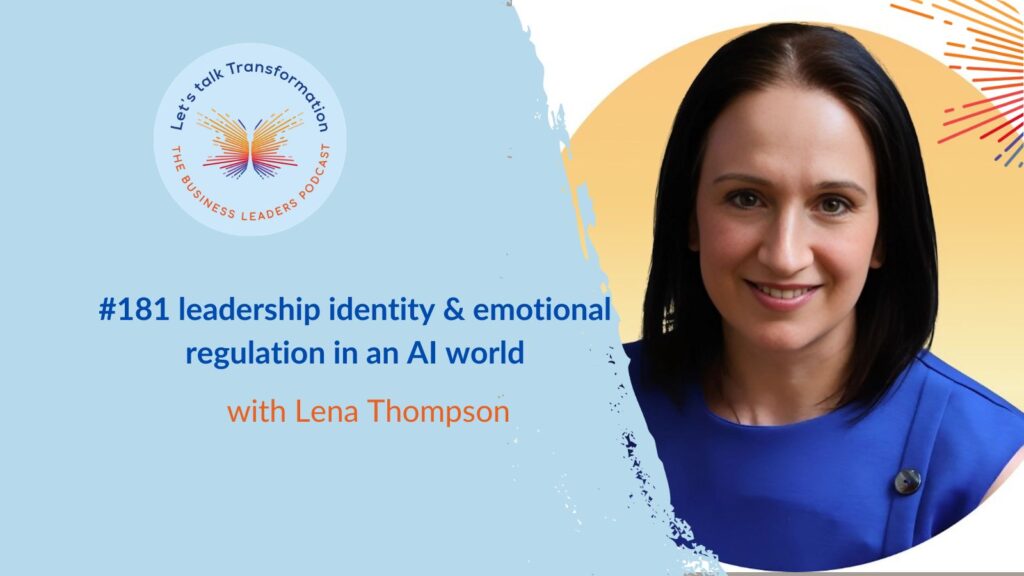
Lena and I discuss how to use emotional regulation and human design to help leaders overcome exhaustion and reclaim their authentic power in the era of AI.
The “strong leader” myth is a primary driver of modern burnout. AI will soon perform 95% of our cognitive data processing. Senior leaders often deny – or are disconnected from – their emotions, outwardly exuding strength for the benefit of others.
If your leadership identity is built on being the “smartest person in the room” or the one who sees patterns first, you are at risk of an existential crisis. The new competitive advantage for leaders isn’t IQ. It’s consciousness and emotional regulation.
We are taught to suppress emotions, wear a brave face, and act with unyielding certainty. But this self-preservation mask is exactly what leads to exhaustion.
Lena Thompson highlights a critical reality: burnout isn’t just about what you do. It is about what you refuse to feel. When you stay in a job or relationship you have outgrown, that internal pressure compounds.
The fix isn’t another week off or a better calendar app. The fix is cultivating a relationship with your emotions. When you pause and label your frustration or impatience, you create space, space where you can move speeds and where better decision live.
Neuroscience suggests that our logical mind operates at just 5% of our potential. The remaining 95% is driven by subconscious patterns. If you only make decisions based on past data, you are destined to repeat the same predictable results. Human design can help executives understand their unique wiring. It’s not about labels or frameworks, but it’s about energy management.
Some leaders are built to work in bursts. Others are built to create consistent output. When you try to force a different energy model onto your team, you foster burnout and stagnation.
Try this strategy for this week:
Spend five minutes every morning without a screen. Connect with what you actually want to experience that day.
Stop checking your phone and start setting your intent.
What is one “old behavior” you are trying to break this month?
The main insights you’ll get from this episode are :
- It is often possible to build mental and physical resilience without having any control of emotions.
- Senior leaders often deny – or are disconnected from – their emotions, outwardly exuding strength for the benefit of others.
- Burnout develops over time as internal pressure builds into illness, depression, collapse.
- In the absence of open discussion of burnout in organisations, human design helps people connect to their emotions and understand themselves, impacting relationships, optimising energy and aiding decision-making.
- Energy management and consciousness in the corporate world help provide a better ‘view’, enabling life to respond to energy as opposed to struggles.
- Energy also affects decision-making and is far more effective than basing decisions on (binary) logic that offers repeat solutions based on past data.
- We are driven by subconscious patterns and developing our intuition teaches us how to trust our impulses.
- Amidst the constant cognitive pressure to deliver, the power of pause is undeniable, particularly in the age of AI when everything is immediate.
- Sometimes it is better to make no decision; and making decisions with awareness creates space to make a different choice.
- Stopping and recognising/feeling emotions builds the capacity to hold more pressure and gives us power over our emotions.
- Scaling human design in the corporate world requires more conscious leaders, or a realisation that things have to change and current tools don’t work.
- There is no limit to what human design can do in the corporate world: elevating consciousness, bringing our best selves to work, allowing us to be authentic and free.
- Taking time in the morning to connect to how we want our day to be programmes our minds to focus on what we want and redirects our brains.
- Reflecting in the evening will offer insight into how our responses differ and require less energy.
Find out more about Lena and her work here :