
Workplace culture is often portrayed as a harmonious collection of professionals working toward a shared goal with shared values. Yet, anyone who has spent significant time in corporate environments knows the reality is far more complex. Beneath the surface of official mission statements and team-building exercises, office dynamics are often defined by power plays, hidden agendas, and distinct personality types that can significantly impact a project’s trajectory.
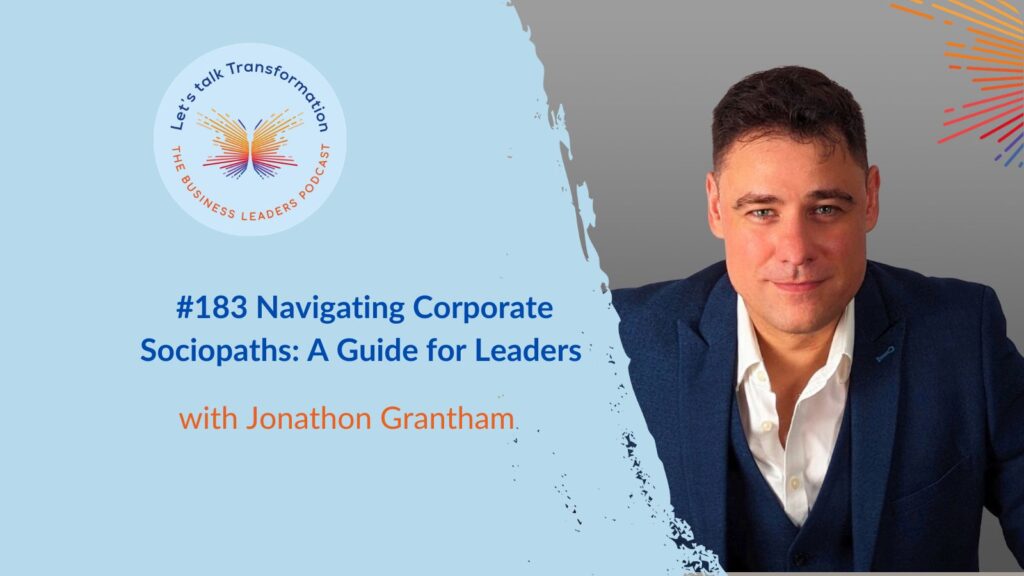
Jonathon and I explore the prevalence of the “dark five” personality types within corporate structures, noting that certain traits are often rewarded by organisational systems. We look at how to identify and work with difficult personality types in the workplace, as well as practical strategies for leading through office politics and dynamics.
While sociopathy, defined by an absence of empathy, is often stigmatised, it functions as a necessary mechanism for high-stakes leadership, such as managing layoffs or major structural transitions. By distinguishing between sociopathic behavior and the more destructive, less useful traits of sadism and spitefulness, leaders can better navigate interpersonal challenges. These behaviors have deep evolutionary roots, making them persistent aspects of human social interaction that cannot be ignored or simply trained away through culture building.
Technology, specifically artificial intelligence, is rapidly altering the landscape of corporate influence. Tools that once required massive data science operations—like those used by Cambridge Analytica to manipulate political outcomes—are now accessible to individuals. This democratization of data manipulation is a significant concern for organizational security. The primary danger of AI in the workplace is not its intelligence, but its ability to be used for unethical ends by those who understand the system. Leaders need to ensure that every interaction with powerful AI agents is logged, tracked, and attributable to a specific user.
Understanding the “dark five” personality traits and their influence on corporate strategy is not just for HR or executive management; it is a vital skill for anyone leading change. When the political currents of an organization become too strong to ignore, the ability to identify the players and their underlying motives allows a leader to maintain their integrity while continuing to deliver results.
The modern leader must be an astute observer of human behavior, a pragmatic technologist, and a firm guardian of ethical processes. Ultimately, the goal for the integrity-minded leader is not to eliminate sociopathic traits—which is likely impossible—but to manage them effectively. The best defense is a combination of radical transparency and a clear understanding of human drivers. Leaders who spend their time fighting against the nature of their peers often lose; leaders who understand the nature of the game and adapt their strategy usually win.
What is the biggest “unspoken” personality challenge you have navigated in your career?
The main insights you get from this episode are :
- The many unethical stories from the corporate world are very relatable but never spoken about.
- The ‘dark five’ highly correlated personality types: sociopaths, Machiavellians, sadists, spitefuls, narcissists.
- Socipathy is helpful at C-suite level, whereas sadists and spitefuls are destructive in leadership and not useful in a business.
- Sociopaths are easier to manage than mixed-trait middle managers who are more diverse yet ambitious.
- The higher up the ladder, the more sociopathy and less of everything else there is; but sociopaths are unpredictable and good at hiding their traits.
- Evolutionary psychology overrides everything, pre-dates humans, and is a fundamental driver that should not be ignored.
- Dominance and submission are also relevant; there must be less dominance 30% of the time to prevent disengagement.
- There are multiple versions of manipulation and power games as well as (unspoken) differences in how they present in males and females.
- DEI can be difficult as the more diverse the workforce, the less likely they are to support each other (lack of affinity).
- Hero ideology cultivation or hero brand concept: narcissists do it because they have to and sociopaths do it because they will benefit.
- Monthly group meetings for praising and criticising is very constructive and motivational but requires trust and the right context.
- Notional team building will fail as teams are about personal connection and mentorship – and leadership with integrity.
- High-functioning sociopaths develop their own ethical and moral code to talk about things they don’t understand; they intellectualise.
- The biggest challenge for AI currently is knowing what the user wants and whether the response is ethical or not, despite its validity.
- AI guardrails for senior leaders are impossible as it is so fast-moving and rules slow things down.
- Basic principles of big system architecture also for AI: logging, monitoring, and recording; logs must also be reviewed by a human.
- Review requires an understanding of the basic human drivers and the ability to recognise cognitive dissonance.
- Learn to work with the traits in the team – acceptance of neurodiversity does not (yet) apply to the dark five personalities, yet they are valuable and must be understood.
Find out more about Jonathon and his work here :