
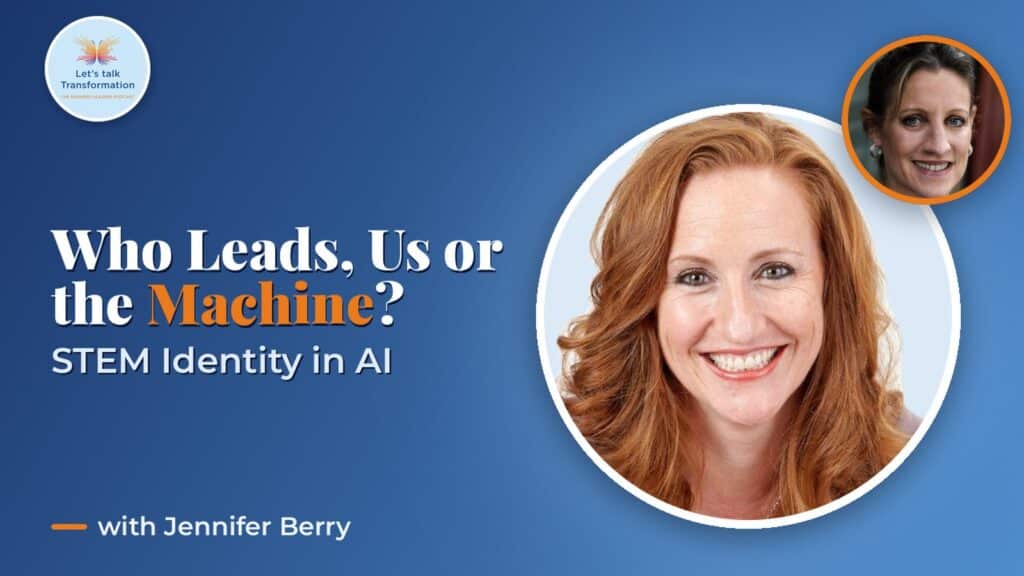
Who is leading, us or the machine ?
Jennifer and I explore why durable skills, hands-on learning, and cross-generational dialogue matter as AI reshapes how we think, work, and lead.
We look at case studies where leaders are willing to let AI decide budget, strategy and genuinely anything else that makes their job easier. Nobody had checked the numbers. Nobody had weighed the trade-offs. A piece of human judgment had quietly moved into a software tool, and often leaders don’t notice until someone asks the right question.
That moment captures the central tension of our time. AI offers speed, scale, and polish. But speed and polish can crowd out the slower work of thinking, questioning, and owning a decision. Skills matter, but identity matters first. Jennifer describes STEM identity as three beliefs: “I belong here. I add value. I can master rigorous challenges.”
Those three beliefs shape how people respond to difficult problems. A young person who believes she/he belongs will raise a hand. A professional who believes his/her ideas add value will speak up in a meeting. Without those beliefs, even talented people stay silent.
Many current leaders built these beliefs the hard way. They failed, tried again, and earned their seats through persistence. The concern now is what happens when AI takes over the tasks that once built that confidence.
Convenience can weaken the very skills it promises to support. SmartLab responds to this risk with a deliberate design choice. Students do not begin with AI. They begin with a problem, a set of materials, and a team. They build something, and it often fails. Students then have to diagnose the problem, talk with teammates, and try again. Those moments build resilience, communication, and critical thinking in ways that a screen cannot replicate.
These are what Jennifer calls durable skills. Unlike tactical skills, which change with each new tool, durable skills last. They include communication, systems thinking, computational thinking, collaboration, and the ability to recover from failure. SmartLab measures these skills with a rubric that facilitators complete after each project. The aim is not to reward a correct answer. The aim is to show measurable growth in how a student thinks and works with others.
Today’s workplace may include five generations at once. Each one brings different relationships with technology. These differences can become strengths. When generations talk openly about how and when to use AI, each one sharpens the others. Younger workers question shortcuts. Older workers remember the value of struggle, and together, they can build norms for responsible use.
Human connection also needs deliberate attention. Many people, especially younger ones, now turn to AI before they turn to a colleague. They avoid looking foolish. They avoid the risk of being wrong in front of others.
Organizations cannot afford to wait for schools to produce ready-made talent. Companies that depend on innovation need employees who think critically, collaborate well, and adapt quickly. Those skills take years to develop.
Businesses need to act now in three ways. First, they can invest in schools by sending employees to mentor students or sponsoring a SmartLab in a classroom. Second, they can build internal training around durable skills. Third, they can use those same skills as criteria when hiring.
Return to the question that started this conversation. Who is leading, us or the machine?
The answer depends on choices made every day. Leaders can ask for raw thinking before polished output. Parents can protect time for play. Businesses can invest in young people before they walk through the door. Schools can teach students to build, fail, and try again.
AI will keep getting faster. Human judgment, curiosity, and courage will decide how we use it. Those qualities are not automatic. They must be built, practiced, and protected.
If you lead a team, a family, or a classroom, start small. Ask one person for their own answer before the screen provides one. Notice what emerges. That moment of effort may be the most valuable thing you do all day.
The main insights you’ll get from this episode are :
- STEM identity for children: I belong, I add value, I can master rigorous challenges.
- Durable skills for the AI age = strong communication, deep distance thinking, computational thinking, critical thinking, flexibility, mastering failure.
- Soft skills are required to lead in an AI-powered world, but the CEOs of the future born into the digital age have fewer social/human skills.
- Personal opinion matters even more in an AI environment – the maxim must be ‘think first, then use AI’ because faster doesn’t always mean better.
- Hands-on, project-based learning is more critical than ever but needs to be ‘manufactured’ these days for children.
- Generational problem-solving differences are magnified by the speed of AI; gen Alpha will hopefully challenge AI, trust it less, and be more cautious.
- SmartLab has ways of working, ways of thinking, and ways of being for children but how do these translate to the workplace?
- Investment by organisations in the workforce of the future is a business problem and essential in such a fast-moving world.
- The education system does not provide young people with the unique skills they are going to need – durable skills as opposed to AI-oriented tactical skills.
- The ‘lab’ approach brings a customised environment into a school in which children can learn durable skills as part of the curriculum to deepen learning.
- Schools currently test for knowledge, whereas the SmartLab rubric tests for skills development, e.g. competent, confident.
- Play is very important for children to liberate them from screens, experience boredom, and (learn to) be creative, imaginative, and collaborative.
Find out more about Jennifer and her work here :
https://www.linkedin.com/in/dr-jennifer-berry-9a05113/
https://www.smartlablearning.com/
For more information on this episode please visit www.transformforvalue.com/podcast
To carry on developing your leadership and building a relevant & high performing team, connect with me here : https://calendly.com/transformforvalue/connect
Work with Suzie
Lead change like this in your own organisation: Human Systems Practitioner