

“Courage is resistance to fear, and mastery of fear, not the absence of fear.” Mark Twain
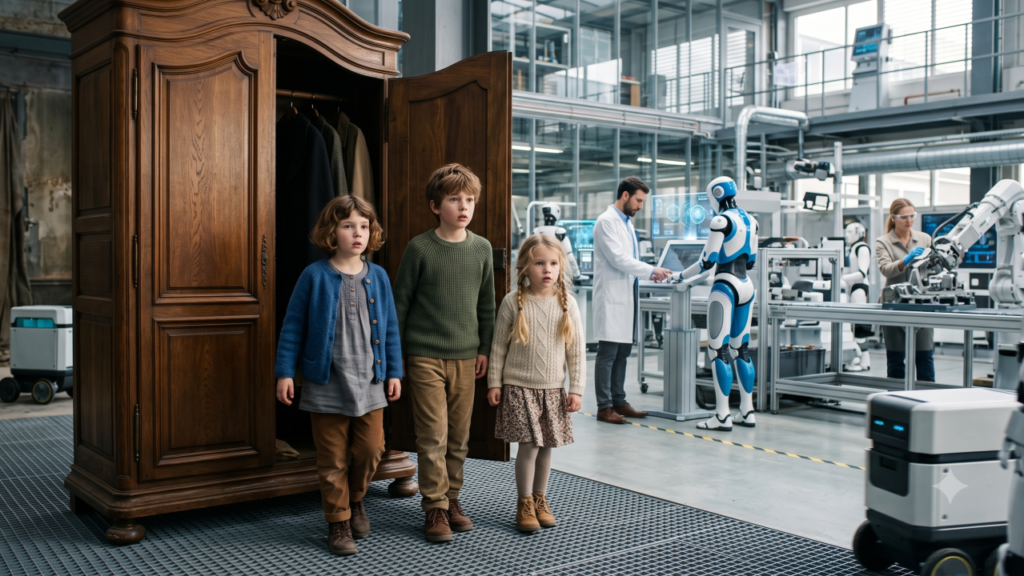
I used to be mesmorised by The Lion, the Witch and the Wardrobe from The Chronicles of Narnia. I remember my brain and imagination working overtime as I followed the characters through the back of the wardrobe and into some unknown, exciting yet sometimes hostile land. When I got to see the film, I found it magical to visit the places I’d imagined and someone else’s visualisation of the same scenes and the same questions of sacrifice, courage, adventure and being bold. I feel like this sometimes when I spar with AI and design different things relatively simply, that I’d only imagined to date. I have always had this type of imagination and spent hours creating games, scenarios, stories, and poems, all of which I dutifully instructed my sisters to help me test and iterate!
Understanding this creative process and how it happens in your brain is the starting point for partnering with AI. Understanding how your brain works, which patterns are running you (for fear and for creativity), is key to regulating your nervous system. Dysregulated humans build dysregulated systems, and dysregulated systems, scaled, are basically the origin story of most organisations I’ve ever worked inside or with. If we want a fairer, more sustainable business world, it doesn’t start with a new framework bolted onto the old one. It starts with understanding the structure on which the system is built, and the organisation’s ‘nervous system’ so to speak. Only then can we attempt to intentionally design for regulation and explicitly regulate people in the given system.
That’s the thread running through every conversation on Let’s Talk Transformation this month: Nell Derick Debevoise on slowing down for more sustainable impact (listen here); Eric Ries on what a company is actually for and how to maximise human flourishing through protecting your purpose (listen here); and Chris Majer (listen here)and Rebecca Hinds on moods and meetings as systems you can design, not events you have to endure because that’s the way we do things here (listen here). Four very different guests, but the same recurring questions: What’s genuinely ours to fix as humans? How do we intentionally design to fix it? What should we simply stop carrying?
AI is forcing the issue whether we like it or not. It’s already faster than us at the tasks we used to prove our worth through – drafting, summarising, optimising, analysing – which is uncomfortable, and also clarifying somehow because it’s pushing back into view exactly what it can’t do: hold a room’s mood, notice when someone’s gone quiet for the third meeting running, decide what’s actually worth building and protecting further, and maximise environments for human flourishing.
Taking a look in the mirror
This reminds me of the words from Cameron Whitcomb’s song ‘The Kingdom of Fear’. The song explores the “kingdom of fear” as a metaphor for the mental walls and anxieties we can build up in our own heads – such as the fear of failure, trauma, and the “what-ifs”. In the lyrics, Whitcomb admits to lying in self-defence by saying he is “great” or “fine”, even when he is deeply overwhelmed and scared. We have all been there – in that overwhelm – looking in the mirror and not liking or being scared of what we see. This is the deeper inner work that is key to understanding the patterns that are running us and why we react the way we do. AI holds this mirror up to us as both individual leaders and organisations. It is not only leaders in organisations though: every leader has had to look in their own mirror to start deepening their understanding of the inner game and step into a more conscious leadership stance. They either see it and find a way round what they say, or embrace the image and start working on it. Every founder also has, at some point, quietly recreated the exact thing they left. You leave the corporate structure because it felt like a cage, and eighteen months later you’ve built yourself a smaller, maybe better-decorated one – although it feels different because there are elements of ‘freedom’ or a different décor and you have a different identity. However, there are often the same patterns, and anxiety about constraints and sustainability, even if there are liberating elements that make it worth it.
If we take the time to stand back and honestly look in the mirror, our formatting from previous environments either is still obviously and explicitly there, or has woven itself into a newer fabric, with the same threads. Nor does our internal formatting change just because we’ve changed environments. Old patterns still run and old triggers are still active – until we look hard enough and intervene intentionally.
So here’s the mirror check: don’t just look blindly at what you see. Get curious about the blind spots. Don’t trade a corporate prison for an entrepreneurial one. If you’re building a business with a silent commitment to prove the old system wrong, you’ll rebuild its worst habits without even noticing, because you never actually questioned them – you just changed environments. Be intentional about what you build, how you build it, and how you protect it. Eric Ries makes this point in his brilliant book, Incorruptible, in a way that’s almost embarrassingly simple yet still so hard to live by and define in today’s systems: define what you’re actually optimising for and what you are not willing to trade in, before growth pressure makes that decision for you (listen here). He reframes profit as the by-product of human flourishing rather than the point of the exercise. Not everyone will agree that this is compatible with staying in business – plenty of reasonable people think mission and margin pull in opposite directions more often than we’d like to admit, but the leaders with the most human impact are the ones who’ve had that argument with themselves before the market has had it for them.
When optimism shines through
Nell Derick Debevoise’s whole practice is built on a rebellious idea: growth doesn’t always mean adding things into your agenda or life. Sometimes, the highest-leverage move a leader can make is subtraction – stopping the meeting, the report or the “best practice” that’s outlived its purpose. In fact, often best practices are the very thing that stymy a system in its effort to grow. If I look at Dave Snowdon’s Cynefin model, this is because they are part of a more ordered world, not a disordered, complex one! Nell’s three-step process is really a permission slip to admit that busyness was never the same thing as productivity, no matter how convincingly it dressed itself up, and that the human brain has an inherent need for calm in order to be impactfully creative and regulated.
This is where I think AI’s optimism actually lives – not in what it produces, but in what it frees us from producing: the status update that nobody reads, or skim reads at best; the meeting that exists because it existed last quarter and no decisions get made, even though it’s nice to exchange and see each other often. If we strip that away, what’s left is more human, not less: judgement, care, compassion, intuition and the ability to sit with an unclear problem without rushing to solve it. If AI can absorb the “more” that never made anyone’s life better, we get our attention back for the “less” that actually maximises the conditions for us to thrive as humans.
That’s optimism I can work with – not because the technology is kind, but because it’s ruthlessly literal about doing what we ask it to. It’s on us to ask better questions and deal with the results of our questioning.
How to manage transition
Brené Brown’s latest book, Strong Ground, gives me the best language I’ve found for something we go through constantly yet rarely name. She describes “locking in” and “locking through” – the deliberate transition between one mode and the next, the way a boat rises or lowers through a canal lock rather than getting slammed by the sudden change in water level. Most of us skip the lock entirely and go straight from a hard client call into school pickup, or from founder-mode hyper independence and self-sufficiency into managing a team, without ever consciously changing gear. Then we wonder why sometimes we feel capsized.
Founders move through more identity locks than almost any other role: corporate leader to founder, founder to scaled CEO, team member to solo contributor and back again more times than anyone warns you about at the start. This is a shift that is prevalent in organisations also – when we change levels, or jobs, or sites, or teams, we don’t spend enough time on what it means for our identity, how we are leaving one system and joining another. What residual tensions and relational baggage are we taking with us? What are we leaving behind? If we underestimate that shift, we’ll keep running yesterday’s operating system on today’s problem.
Chris Majer’s work on mood is useful here too. He treats mood not as something that happens to you, but as a system you can actually design, the same way you’d design a process or a product. Left unmanaged, a bad mood doesn’t just make Tuesday worse, it quietly becomes company culture. Locking through, on purpose, is how you stop that transfer happening on autopilot. Leadership identity is being challenged every day as AI advances and changes the rules of how leadership is seen, heard and experienced.
Grounded confidence
Why does any of this matter more now, in the AI era, than it did five years ago? Because grounded confidence – the kind Brown describes as coming from preparation and values rather than certainty – is precisely what a machine cannot manufacture for you. We are once again back to one of the most important leadership skills in navigating uncertainty and the AI era – holding tension and paradox. No one is fearless; they’re disciplined in their courage. No one is free of ego; they practice humility instead. No one is free of shame; they practice self-compassion. It is not binary, and is never a question of ‘either’ / ‘or’ but moreso how do I gain clarity in the grey zones of systems as they evolve, grow and adapt? We see it in nature as cells in our body adapt and adjust to chronic injury or inflammation, allowing them to survive despite not achieving complete recovery. They navigate the tension of the grey zone until they can regulate the system, and this happens in distinct stages, not in one go. These are choices, intentional practices repeated daily, and they’re the one leadership advantage that cannot be automated.
Build your human systems with the same rigour you’d bring to any other system. Recognise loneliness early – solo founders in particular go quiet in exactly the way that precedes real trouble, and the fix is rarely more work, it’s one honest courageous conversation. Learn voraciously about what AI can actually do, then teach it to someone else, because explaining something is how you find out whether you really understood it. Question constantly – not because you doubt yourself, but because relevance now has a shelf life measured in months, not years. And don’t be afraid to ask for help. Grounded confidence was never a synonym for going it alone, yet we often think that doing it all is a symbol of strength.
Indigenous traditions and stories offer a profound lens on complex systems adaptation. They demonstrate that resilience requires a community to shift its practices in response to environmental, social, or climatic changes, while steadfastly preserving its foundational cultural values. The ancient story of the Three Sisters – an agricultural tale originating from the Haudenosaunee Confederacy and widely shared across Indigenous communities in North America – illustrates this brillantly as it visualises the relationship between the corn, the beans and the squash (the three sisters) and the onset of drought and the need to adapt. It is a foundational narrative that transforms complex ecological principles into a story of adaptation, cooperation, and systems thinking.
In contemporary systems thinking and ecology, this tale mirrors the concept of symbiosis and polyculture. The Three Sisters story is a blueprint for adapting to changing conditions by building an interdependent system. Rather than trying to engineer or force a single element to overcome a single problem, the story teaches that true systemic adaptation relies on diversity, mutual reciprocity, holding different polarities and adjusting our connections to the ecosystem.
Thinking in systems terms, especially when you don’t have to, is a good way to go to the habits gym and strengthen the muscle before you need it! That’s the way forward: not out-processing the machine, but out-noticing it and preparing the muscle for when it’s needed. We need to notice what we notice about the system we are working in and constantly ask ourselves where we need to upskill ourselves and others, and where we are stuck – the mood in the room, the meeting that shouldn’t exist, the version of yourself you’re quietly at risk of building another cage for or accepting as the status quo because it’s easier. AI can help us see all of that far more clearly, if we’re willing to actually look and then act on what we see.
Thank you for reading.
If this resonates with you please share your thoughts in the comments, and subscribe for more thoughts on human systems.
You can also find more subjects like this in my podcast, Let’s talk Transformation, available on Apple Podcast and Spotify and youtube.
If you’re looking to bridge the digital gap and lead your ecosystems differently, check out our Human Systems Practitioner course : https://transformforvalue.com/human-systems-practitioner/