
For over a century, organisations have relied on a rigid, factory-inspired model of how we think. We assume that every worker operates on a standard cognitive rhythm, thriving under the same conditions of open-plan offices, back-to-back meetings, and eight-hour shifts. These organizational habits were born of convenience, not science. We are currently designing our entire professional lives around assumptions that lack any grounding in neuroscience.
The reality is that the brain is the most complex system known to humanity, holding roughly 86 billion neurons and trillions of neural connections. While leaders and managers continue to force employees into uniform boxes, the rapid rise of Artificial Intelligence is quietly shifting the cognitive landscape. We are operating in a gap where the decision-makers behind our work structures often possess little understanding of the cognitive biology they govern.
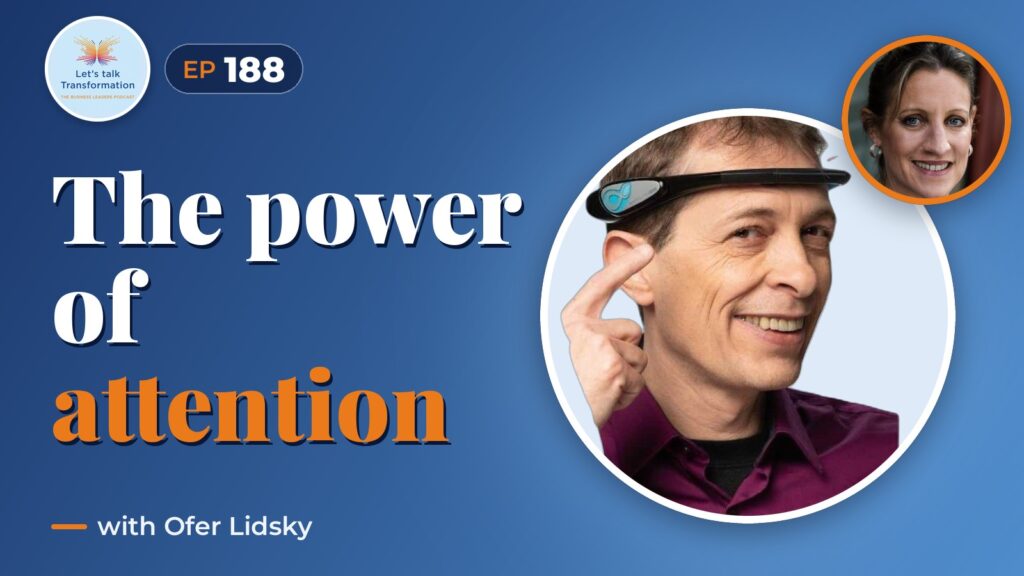
Ofer, as a technologist who has spent a decade applying neurofeedback to the human mind, recognises that treating the brain like a computer is a fundamental error. If we want people to flourish rather than just perform, we must move away from the obsession with standardisation and start respecting the individual architecture of the human mind and the fact that this can look different in different people.
We are currently also seeing a decline in global attention spans. The average human attention window online is now just 2.8 seconds. When you land on a page, you have less time to capture a user’s attention than a goldfish.
Ofer developed neurofeedback technology to bridge the gap between clinical needs and personal development. By using EEG sensors to track brain wave activity, individuals can receive real-time, visual, and auditory feedback on their focus levels. In practice, this looks like a game where the user serves as the pilot of a digital vehicle, controlling its movement through focus alone. When the user becomes distracted, the feedback loop prompts them to return to a state of engagement.
This process steps outside the traditional box of corporate and educational uniformity. By treating attention as a skill to be trained rather than a fixed personality trait, we move toward a model of individual development. This is particularly relevant for those diagnosed with ADHD, as it offers a way to strengthen prefrontal cortex activity—the area often associated with sustained focus. The effectiveness of this method stems from its millisecond-long feedback loop, which is far more potent than the annual performance reviews we rely on in traditional management.
By providing a way to measure and improve cognitive state, this technology empowers users to take ownership of their own mental performance. It demonstrates that we are not locked into our current cognitive limitations. With the right tools, we can train our attention mechanisms to handle the complexities of a distracted, high-tech world, ultimately fostering a higher degree of agency and self-mastery in our work lives.
As AI integrates further into our workflows, the value of the human “edge”—our ability to think critically, connect dots, and navigate ambiguity—will only increase. Leaders should be wary of over-automating processes that require human nuance. The goal should be to use machines to handle the rote tasks so humans can flourish in roles that require empathy, creativity, and high-level judgment.
The strategy for the future isn’t more software or faster tools, it’s about building “flexible structures” that accommodate different thinking styles. We must hold our management theories with humility and pivot from a culture of constant, fragmented attention to one that values deliberate, focused, and human-centric interaction.
Whether through neurofeedback, better meeting design, or simply setting our phones aside to listen to one another, small changes can yield significant cognitive benefits. The path toward organisational health requires us to accept that our differences are not problems to be solved, but assets to be utilized. As we look ahead, let us commit to building environments that nourish the brain rather than exhausting it.
Are your current team rituals helping your people think, or are they just keeping them busy? It’s time to move from managing output to supporting human flourishing.
The main insights you’ll get from this episode are :
- The human brain is the most complex system known in the universe – we don’t know how a neuron works and neither do we understand consciousness.
- It functions in a totally different way from a silicon-based computer; no computer can truly understand, only process large-scale mathematics/data.
- Unlike AI, the human brain has taken millennia to evolve and only consumes 20W of energy – this evolution produces an optimised system.
- Is AI conscious? No computer is conscious, and intelligence requires understanding, which we also do not fully comprehend.
- We can learn more easily than we can unlearn: learning is repetition to create new neural pathways.
- The brain-computer interface based on electromagnetic brainwave frequencies produces neurofeedback, i.e. feedback in real time to teach something new.
- Brain training for the third age is aimed at retaining cognitive performance.
- Companies are built by people and thrive on the connections between them therefore it is advisable to adapt rules to different people/brains.
- AI produces amazing results in certain (scientific) fields but has a very negative impact on the population at large who have no need to think or learn.
- Education systems are not evolving and still based on the ‘banking’ system whereby the teacher deposits information into students’ mind.
- Project-based learning is proven to be more effective – it introduces the element of experience and is interesting.
- The human hippocampus is shrinking, which is a very scary prospect for the future and those who will be the leaders.
- The western world is organised around efficiency, which does not equate to human flourishing.
- Making neurofeedback accessible, affordable, and feasible is a gamechanger to help people increase their attention.
- Attention is a competitive advantage these days and hijacking it is very destructive, with fragmented attention often described as ‘busy’.
- Preventive measures include paying attention to our lack of attention, practicing more and managing our time correctly – the brain is not a multitasker by design.
Find out more about Ofer and his work here :