

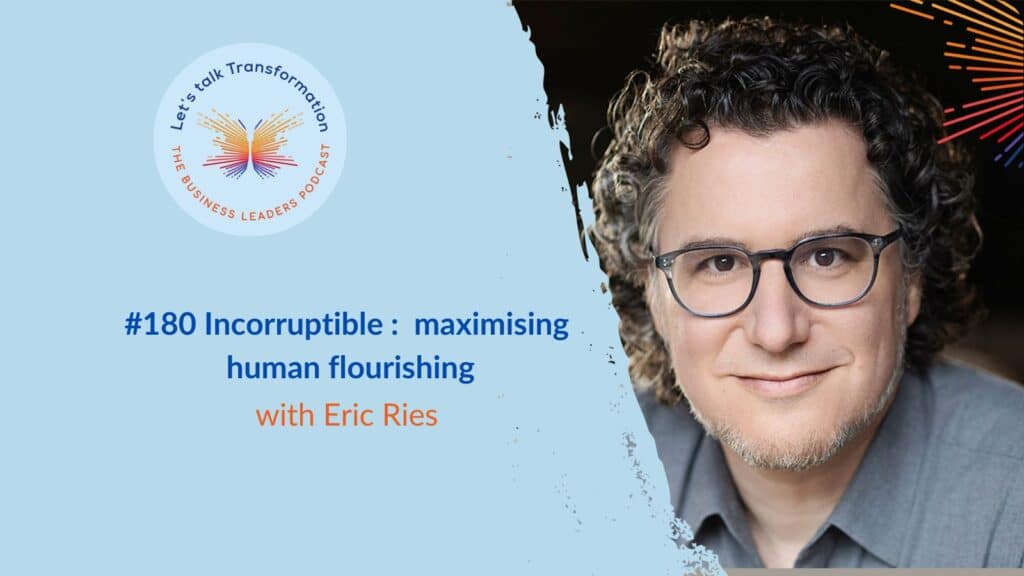
What happens when a company built on trust and purpose faces the immense pressure of quarterly profits?
Eric and I discuss why good companies go bad and explore the structural blueprint to keep your business mission-driven, soulful, and incorruptible for the long term. We go from story to story of human centric and purpose driven founders trying to combat the corrosive effects of financial gravity. We explore why “financial gravity” pulls good companies toward bad decisions and how leaders can protect their mission.
The companies that last aren’t the ones that avoid pressure. They’re the ones that decided early what they would refuse to trade away. This is an ethical and a leadership question. One of organizational soulcraft, and it’s one that every single person listening gets to answer in some small way. In order to build orgs that are truly strong we need to pay special attention to the exoskeleton that separates inside from outside – this is the art of organisational soulcraft — designing the deep structural foundations that give organisations strength – governance.
This involves embedding values directly into the legal and structural foundation of a business. A central element of this blueprint is adopting a Public Benefit Corporation (PBC) status, which formally aligns the company’s purpose beyond simple profit maximization. We explore the importance of appointing mission guardians and utilizing board structures that ensure accountability to long-term goals rather than just quarterly financial reports. These mechanisms help protect the engine of value creation from outside interference.
Modern business often relies on a set of “best practices” that, ironically, can destroy shareholder value. Bundling cost, short term thinking and choosing convenience over mission is still very much the status quo, even if there are people that believe otherwise. This is the downwards pull of financial gravity
Profit should be redefined as the result of maximizing human flourishing. To sustain this, leaders must maintain a “culture bank” where every decision is an opportunity to make a deposit by acting in accordance with core values. The example of HEB, where a manager allowed customers to take necessary supplies during a power outage, illustrates how a strong internal culture empowers employees to act consistently without awaiting corporate permission. This operational coherence ensures that the company’s mission remains the guiding force in daily interactions.We all can and must act, and when individuals recognize they are not just victims of a system but are “traffic” within it, they can then reclaim the agency necessary to build and preserve truly meaningful organizations.
It is time to move past the myth of shareholder primacy and stop chasing the market. We need to start building engines that can sustain themselves, organizations that create more value than they extract. The future of our economy depends on our willingness to design better, more soulful institutions.
What is one structural change you could make this week to better protect your core mission?
The main insights you’ll get from this episode are :
- An incorruptible company must be structurally, intrinsically and permanently soulful.
- In the fiduciary hierarchy – customers, employees, shareholders – shareholder value is only created by serving the other two first.
- Building an ethos attracts loyalty to successfully grow a company, but the pull of financial gravity undermines this (i.e. making money without creating value).
- The golden goose is a recurring problem in our economy – systems should counteract human failings, not amplify them (i.e. kill the golden goose).
- The ability to operate the engine of a company is required to run it successfully; purpose-driven companies are proven to outperform others.
- Forces at work below the surface are experienced indirectly in a company but are very impactful and have a universal warping effect, e.g. ‘financial gravity’.
- The ‘art of organisational soulcraft’ = governance, but in accessible language to create the conditions to be incorruptible.
- Governance is foundational and the blueprint for the solution is composed of information that is widely available (but counter to shareholder primacy).
- A sound definition of profit is to maximise human flourishing, with leadership and operational techniques creating an aligned culture, a ‘culture bank’.
- The simple rule of a strong company culture is to only make deposits and never withdrawals from this culture bank.
- Trustworthiness is an asset with intangible value for customers; creating good stories becomes company lore.
- Individual agency is important in the face of destructive forces, as highlighted by the effort companies make to dispirit us.
Find out more about Eric and his work here :
https://howisincorruptiblegoing.com